Step 1: Credit Report
A Credit Report does not simply show your score; it provides a detailed record of your entire financial history. If you have a history of delinquency or default on a previous mortgage, it will be very difficult to get approved for a loan. Recent bankruptcies or other major financial issues will also create significant challenges.
A score of 680 or higher is generally acceptable, but 740 or higher is considered stable and secure. The score used is the middle value among those pulled from the three major credit bureaus. If there are two or more applicants, the lower of the two applicants’ middle scores will be used.
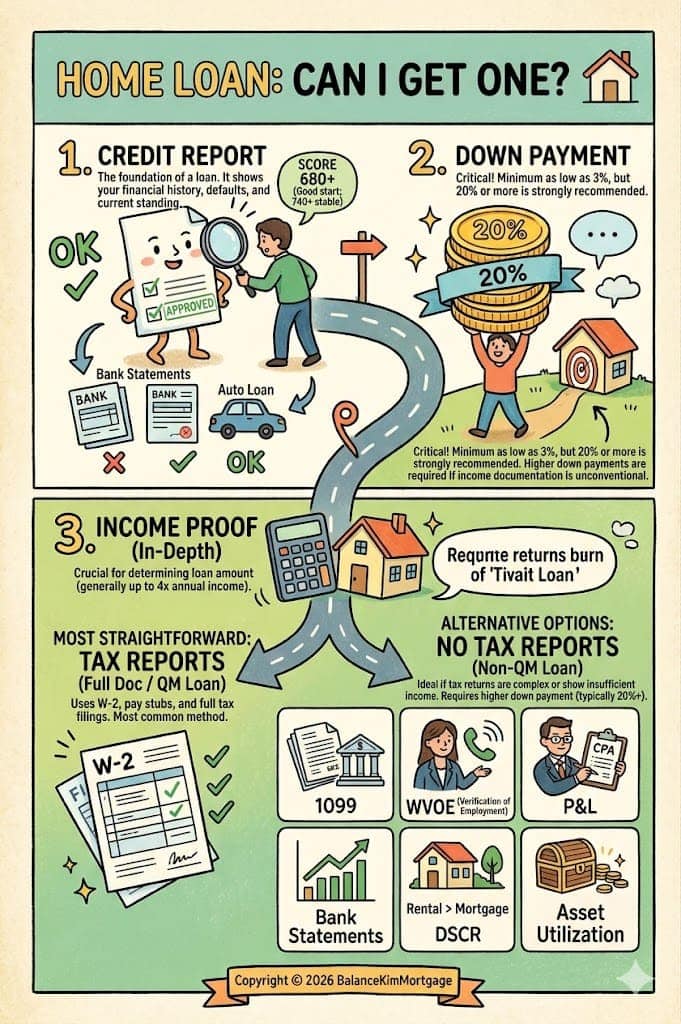
Step 2: Down Payment
The minimum down payment required can start as low as 3%. However, a down payment of around 20% is generally recommended. In particular, if you have not reported a high amount of income on your taxes, lenders will typically require 20% or more.
These first two conditions are straightforward: if you meet them, you are good to go; if not, qualification will be difficult. Even if you pass these steps, the ultimate core factor is the next one.
Step 3: Income
How do you prove your income? The amount you can borrow is roughly 4 times your annual income. For example, if your income is $100,000, it means you can generally qualify for a loan amount of around $400,000.
Adding the down payment to this gives the home price I can afford. The final hurdle is ‘how to verify my income.’
The most straightforward approach is using your Tax Returns. This includes your salary and any other regular, recurring sources of income. This is referred to as a Full Doc or QM (Qualified Mortgage) Loan.
If, for any reason, your income is not enough to qualify for your target loan amount, there are several ways to get approved. You can check them on the Non-QM page.