
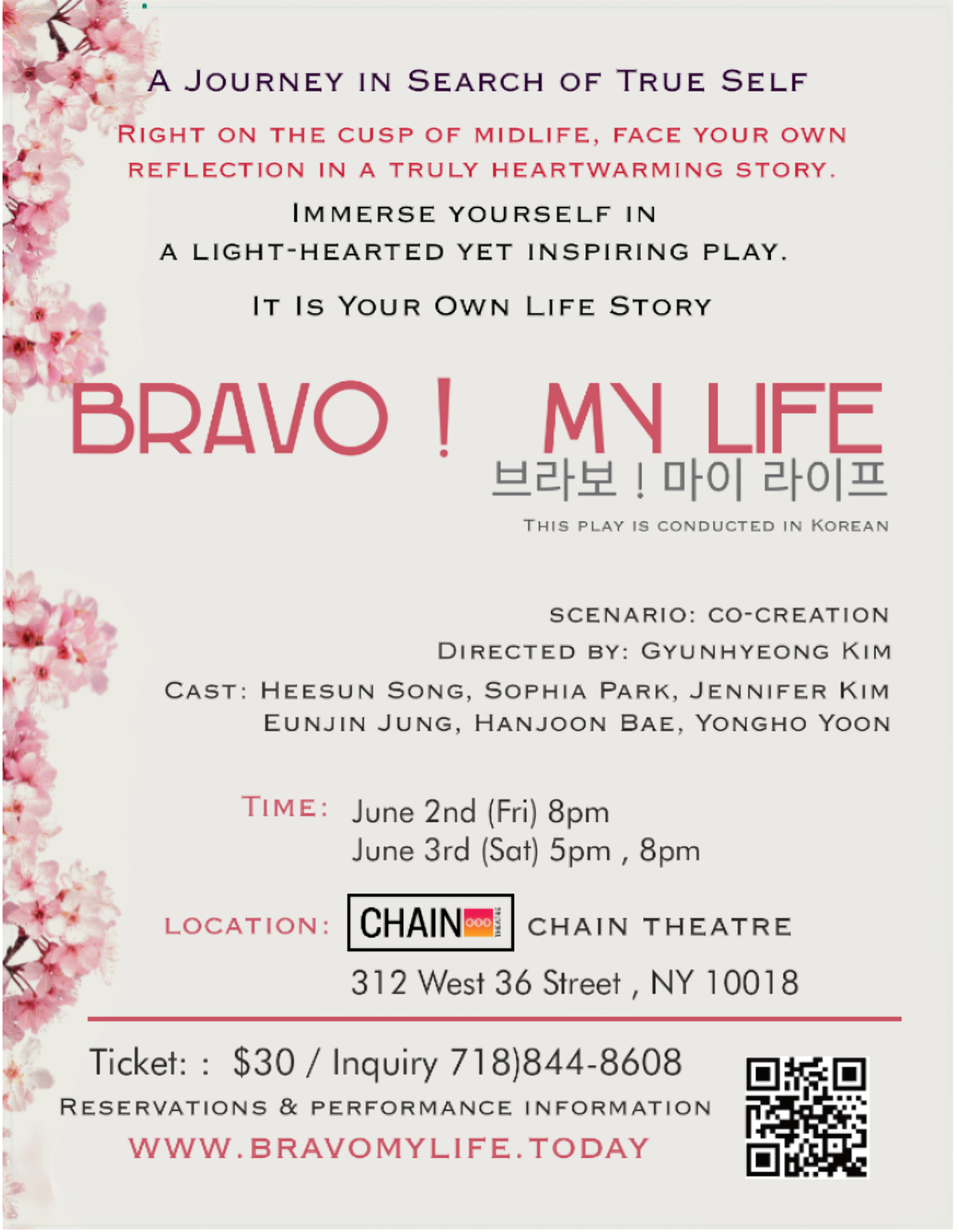
– Title: A theater performance celebrating middle age, presented by Hanmulgyeol21 Institute — [Bravo My Life]
written and performed in Korean
– Running Time: 1 hour 30 minutes
– Dates: Friday, June 2, 2023, 8:00 PM
Saturday, June 3, 2023, 5:00 PM & 8:00 PM
– Venue: Chain Theatre
312 W 36th Street, New York, NY 10081
– Cast: Heesun Song, Sophia Park, Jennifer Kim, Eunjin Jung, Hanjun Bae, Yongho Yoon
– Directed by Gyunhyeong Kim
– Presented by Hanmulgyeol21 Institute
– Organized by KCMB-TV
Program Note
This show was conceived with two purposes in mind.
One is to bless the lives of the middle-aged living far from home in this foreign land — especially the women who, more than anyone, live lives of sacrifice as wives and mothers. The other is for us, as Koreans leading the 21st century, to stand tall and proud.
We all left the country we once called home and now live in this land of America, where the mountains and rivers were once unfamiliar to us. One year, two years, five years, ten years — and before we knew it, thirty years, then forty. There is not much time left to live. Our parents back home have either passed away or have grown so old that even living itself has become difficult for them. The children we raised with such devotion are now leaving us to live their own lives, just as we once left our own mothers and fathers.
They say that all who meet must eventually part. People repeat this cycle of meeting and parting endlessly. Yet someone becomes another’s parent, raising that child with every ounce of care and passion — and still, when the day comes that the child grows distant, an emptiness is unavoidable. Of course, I did the very same to my own parents. And still, still, a quiet loneliness remains in a corner of the heart, and there is nothing to be done about it.
How often have I sought out my parents? Have I repaid even a fraction of the love they gave me? What do I want from my children? Am I not, perhaps, childishly demanding that the love I gave be returned to me? Have I lost my strength, run out of things to do, and simply been wasting the rest of my life playing golf?
And yet, still, I am living with all my heart. Even if my children forget to reach out to me, even if my husband or my wife forgets to offer a warm hand, I will go on living exactly as I do now, until the day I die. For my parents, for my husband and my wife, for my children, I will do everything I can and remain standing until the very end. Because that is middle age — that is me. Myself, as a person in the middle of life.
Bravo, my life! Bravo, middle age!
Director’s Note
People often say that theatre and film are similar. But theatre is made of imagination, while film is made of substance. In theatre, when actors speak of the bright moon in the sky, the audience simply accepts it as so. But if a film says the same thing, the very next scene must show that bright moon. This is why theatre is a highly limited art form — and yet, at the same time, a limitless one.
This is precisely where the power of theatre comes from. With nothing more than simple actions and a few spoken words, an entire world can be created on stage. How is this possible? Perhaps it is because theatre is a space of direct communication, where human beings meet one another face to face. Of course, in forms such as dance or music, the stage and the audience also meet directly. But dance and music are woven from a particular code, and to truly understand them, one must know that code. Theatre, however, is coded on the very way we live our lives, and so anyone can easily and simply understand and communicate through it. This is the possibility theatre holds.
I place great value on this possibility of theatre. And I prefer to create theatre that draws out this very strength. I do not care for the recreation of reality bound by rigid forms. Instead, I want to make theatre into a space of communication — not a performance that simply throws something from the stage to the audience and ends there, but one in which communication flows both ways.
I hope that through this kind of theatre, the audience can come to share with me what I am thinking.
(Graduate of the Department of Theatre and Film, Hanyang University; Ph.D. in Theatre Studies, Université Paris III, France; former Associate Professor at Honam University; theatre and musical theatre director; writer)
CAST
Heesun Song
As Rosa — A nun. Having never lived a conventional family life directly, she retains a certain purity.
Sophia Park
As Kyungsil — She once tried to prove her own worth in life by pursuing something of her own, but for various reasons, she settled into life as a full-time homemaker.
Jennifer Kim
As Eunju — A mother and wife raising two sons, married to a husband who loves golf, and running a nail salon. Her children have grown and left home, and her husband, obsessed with golf, has drifted away from the family as well. Left on her own, she works hard to hold the family together.
Eunjin Jung
As Jeonghee — Unmarried, a middle-aged woman who lives for the thrill of making money through various business ventures. Unbound by the constraints of family life, she leads a life that is, in some ways, freer and more comfortable.
Hanjun Bae
As the Doctor, the Two Sons, and the Professor
Creative Team
Director: Gyhunhyeong Kim
Script Team: Jannice Chang, Kyung A Lee, Cast, Director
Set Design: Sophia Park
Lighting Design: Chang Kyu Lim
Lighting Operator: Hara Kim
Sound/Music: Jake Kim
Synopsis
This show is set against the backdrop of a journey.
After the long pandemic finally comes to an end, people begin to move again. Our protagonists, too, set out on a trip. It isn’t a long journey, but even so — how joyful it is simply to step away from the everyday? Through travel, our protagonists find a chance to look back on their lives once more.
For Eunju, who runs a nail salon, the empty space left by her husband and children feels far too large. In life, she feels isolated, alone, set apart from everyone else. Kyungsil, a full-time homemaker, hasn’t suffered any particular hardship, and yet traces of her recent menopause still linger. Life, after all, is not always joyful. Jeonghee, who has been working hard and is now taking a brief pause, is weighing what to start next. She may not be suffering anything in particular, but living alone, she, too, feels lonely at times. And then there is Rosa, a nun, living a life entirely different from the others. She, too, is not always at peace with her own life. In particular, she takes on the pain that others feel as her own, and through that, lives her own life all the more earnestly.
The place these women travel to is Washington, D.C. As they visit a few sites, they find moments to talk — about the lives of women, about being Korean. They long for the past at times, but in the end, they cannot leave the present behind; they simply remain faithful to the life given to them, hoping for a better tomorrow.
On the drive home, they fall asleep — hoping for a better future.
What might that better future we hope for actually be? Perhaps, in the end, it is something very simple. A husband and wife who love one another. Children who are devoted to their parents. People who trust and depend on one another. In a word — a life that has faded a great deal in our times, but is, in truth, a perfectly ordinary one.
Isn’t this — simple as it is — the timeless, unchanging truth about human happiness that runs through all our lives?
Production Process
The defining feature of this production is that the entire cast constructed the script together through discussion, following a concept called ETA — Education Through Acting.
The production took a total of five months to complete.
The first month was devoted to building the script. The group met online three times a week, for about two hours each session. The first step of discussion was for each participant to present the themes and plots of works they had read in the past, and from among these, to choose together the theme that resonated most deeply with everyone.
The second step was story creation. From the variety of stories presented in the previous stage, new stories were shaped, and participants also shared stories they personally considered important or had experienced firsthand. Through this process, the story of the play gradually took form.
The third step was writing the lines. Depending on the scene, participants spoke their own thoughts aloud, wrote out their own roles, or simply exchanged dialogue back and forth and transcribed it into lines. Through this process, the script was completed.
Once the script was finished, the next stage was the reading process during rehearsals. Reading refers to practicing how to deliver the lines before they have been memorized. Because this stage focused specifically on speech alone, it was carried out online for one month — three times a week, about two hours each session — reading through the entire script and working out the general approach to delivery.
After the reading process came blocking — the stage of setting each scene into physical action. Since this could not be done online, it was carried out in person. Rehearsals were initially held three times a week, two hours each, but because the demands of the production were placing too heavy a burden on each participant’s personal life, rehearsals were reduced to twice a week. This stage continued for two months before moving toward performance.
In the final week, the production underwent a technical rehearsal — coordinating the stage with lighting, sound, and other technical elements — followed by a dress rehearsal, a full run-through of the entire production, before the performances took place on the final Friday and Saturday.
The process described above followed the ETA SYSTEM, developed by director Gyunhyeong Kim.